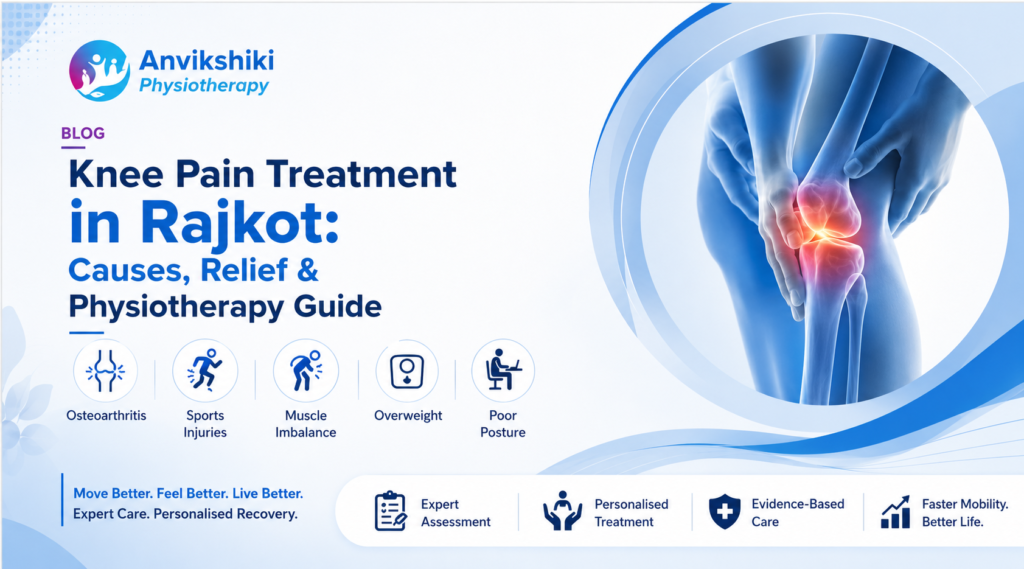
Knee Pain Treatment in Rajkot: Physiotherapy Guide
Home About Services Conditions We Treat Gallery Blogs Contact Us Home About Services Conditions We Treat Gallery Blogs Contact Us Edit Template Home/Blog/Knee Pain Treatment Physiotherapy Guide · Rajkot Knee Pain Treatment in Rajkot: Causes, Relief & Physiotherapy Guide Why your knee actually hurts, when it’s worth worrying about, and how targeted physiotherapy — including the approach used at Anvikshiki Physiotherapy — treats the cause instead of just the symptom. 7 min read Anvikshiki Physiotherapy, University Road, Rajkot Knee pain has a way of quietly taking over daily life. It starts as a twinge on the stairs, then it’s discomfort during a morning walk, and eventually it’s something you plan your whole day around. Whether it comes from age, arthritis, an old sports injury, or a recent surgery, knee pain is one of the most common reasons people in Rajkot walk into a physiotherapy clinic. Here’s what actually causes it, when it’s worth worrying about, and how physiotherapy treats it properly. The Mechanics Why the Knee Is So Prone to Pain The knee is a weight-bearing hinge joint that absorbs enormous mechanical load with every step, squat, and stair climb. It relies on a tight coordination of ligaments, cartilage, tendons, and surrounding muscles — particularly the quadriceps, hamstrings, and hip stabilisers — to stay stable and pain-free. When any one of these components weakens, tightens, or gets injured, the knee often takes the hit, even if the root cause lies elsewhere, such as a weak hip or a stiff ankle. This is exactly why treating knee pain by focusing only on the knee itself often falls short. A proper physiotherapy assessment looks at the entire movement chain — hip, knee, ankle, and posture — to figure out what’s actually driving the pain. Diagnosis Common Causes of Knee Pain Osteoarthritis Gradual wear of knee cartilage, common with age — stiffness and pain that’s often worse in the morning or after rest. Ligament Injuries ACL, MCL, or PCL sprains and tears, often from sports or sudden twisting movements. Meniscus Tears Damage to the joint’s cartilage cushion — from a sudden injury or gradual degeneration over time. Patellofemoral Pain Pain around or behind the kneecap — common in people who run, squat, or climb stairs frequently. Post-Surgical Pain Following knee replacement, ligament reconstruction, or arthroscopic procedures. Overuse & Imbalance Weak quadriceps or tight hamstrings placing uneven, repeated load on the joint. Referred pain is worth flagging separately — hip or lower back issues can present as knee pain, which is one more reason a whole-chain assessment matters more than treating the knee in isolation. Pattern Recognition Knee Pain Looks Different Depending on Your Lifestyle The cause of knee pain often tracks closely with how someone spends their day. Active individuals and athletes tend to see ligament sprains, meniscus tears, and patellofemoral pain from repetitive loading, cutting movements, or poor landing mechanics. Office workers and people with long commutes more commonly develop pain from prolonged sitting, weak hip and thigh muscles, and stiffness that builds up from a lack of movement through the day. Homemakers and those who spend a lot of time on floors or squatting also frequently report anterior knee pain from repetitive deep-flexion positions. Recognising which pattern applies to you helps a physiotherapist narrow down the likely cause faster — which is part of why a thorough intake conversation matters as much as the physical exam itself. Red Flags When You Should See a Physiotherapist Occasional mild soreness after a long walk usually isn’t a red flag. But these signs mean it’s time for a proper assessment rather than waiting it out: Pain that persists for more than a couple of weeks Swelling, warmth, or a visible change in the shape of the knee A feeling of the knee “giving way” or locking Pain disturbing sleep or limiting walking, stairs, or standing from a chair Knee pain following a fall, twist, or sporting injury Ongoing stiffness that makes mornings noticeably harder Left unaddressed, minor knee issues often compensate into bigger problems — an altered gait to protect the knee can quietly strain the hip, the opposite leg, or the lower back. Treatment How Physiotherapy Treats Knee Pain Effective knee pain treatment isn’t a single fix — it’s a structured process built around your specific diagnosis: Assessment First Evaluating gait, joint range of motion, strength, swelling, and movement patterns to find the actual source. Manual Therapy Hands-on joint mobilisation and soft tissue work to reduce stiffness and improve mechanics. Electrotherapy TENS, ultrasound, or IFT used to manage pain and support tissue healing. Targeted Strengthening Building quadriceps, hamstring, and hip strength to properly support the joint. Gait Retraining Correcting compensatory walking patterns that develop around pain. Phased Post-Surgical Rehab Following the surgeon’s timeline to safely rebuild strength and range of motion. The goal at every stage is the same: address why the knee is under stress, not just numb the pain temporarily. Local Spotlight How Anvikshiki Physiotherapy Approaches Knee Pain Anvikshiki Physiotherapy University Road, Rajkot · Est. June 2019 Anvikshiki Physiotherapy treats knee pain across several of its core condition categories — arthritis, joint and muscle pain, post-surgical rehabilitation, and geriatric rehabilitation — which together cover most of the reasons people develop knee pain in the first place. Founded by physiotherapist Mrs. Falak Tripathi, the clinic’s approach centres on identifying the actual mechanical cause of pain before building a treatment plan, rather than issuing a generic set of exercises. For knee osteoarthritis, the clinic focuses on joint mobilisation, controlled strengthening, and activity planning to keep the joint moving without accelerating wear. For post-surgical knee cases — such as total knee replacement or ligament reconstruction — treatment follows a phased approach: protecting the repair first, then progressively rebuilding strength and function. For older patients, knee pain is treated alongside balance and fall-prevention work, since knee weakness and fall risk are closely linked in geriatric rehabilitation. “To eradicate needless dependency from our patients and make them ready to thrive in the future.” — for
Knee Pain Treatment in Rajkot: Physiotherapy Guide Read More »